Predictive Maintenance vs. Preventive Maintenance: What’s the Difference and Why It Matters
Every maintenance leader wants fewer surprises, better reliability, and more control. To get there, you need the right mix of strategies, and that starts with understanding the difference between preventative and predictive maintenance. Each approach offers unique benefits, and knowing when to use which can improve uptime, reduce costs, and create a clearer roadmap for your maintenance operations.
If you’re responsible for assets, teams, budgets and uptime, understanding the difference—and how to apply each—can help you make smarter decisions about maintenance strategy, software, and resource allocation.
In this post we’ll:
- Define preventive and predictive maintenance approaches
- Show how they differ
- Discuss key benefits and challenges of each
- Offer practical examples of how each plays out in real facilities
- How to integrate predictive and preventive tasks into your maintenance plan
Definitions
Preventive Maintenance
What is preventive maintenance?
Preventive maintenance (PM) is proactive and schedule-based. Tasks are completed at defined intervals—time, usage hours, seasons, or other triggers—regardless of an asset’s real-time condition.
Typical examples include:
- Replacing HVAC filters every 3 months
- Inspecting motors after every 500 run-hours
- Annual calibration of sensors or metering equipment
The goal is simple: reduce the likelihood of failure by staying ahead of wear and tear.
Benefits:
- Predictable downtime windows
- Straightforward implementation across large asset portfolios
- Long-term improvements to reliability and lifespan
- Ideal when assets are simpler or don’t have sensor/IoT capabilities
Challenges:
- You may perform maintenance earlier than necessary
- Some assets degrade at different rates, making fixed schedules imperfect
- Technicians may be tied up on planned work instead of addressing higher-priority issues
Predictive Maintenance (
What is predictive maintenance?
Predictive maintenance (PdM) relies on real-time or near-real-time data—such as vibration, temperature, pressure, energy usage, or anomaly detection—to determine when maintenance is actually needed.
Instead of the calendar telling you when to act, the asset tells you when to act.
Condition indicators such as vibration spikes, overheating trends, or unusual energy draw can automatically trigger a work order before a failure occurs.
Benefits:
- Maintenance happens only when necessary—reducing labor and parts waste
- Significant reductions in unplanned downtime
- Extended asset lifespan due to early detection of issues
- Better visibility into overall asset health
Challenges:
- Requires sensors, integrations, and data infrastructure
- Higher upfront investment
- Data quality, analytics, and proper threshold settings are critical
- Not all assets justify the cost of instrumentation
Predictive vs Preventive Maintenance: Key Differences
Benefits & Challenges of Each Approach
Preventive Maintenance
Benefits
- Easy to plan, budget, and schedule
- Provides stability and predictability for teams
- Improves reliability for most standard building systems
- Works across a wide range of assets, even older or unconnected ones
Challenges
- May waste parts, time, or labor on healthy assets
- Can’t always predict unexpected failures
- May not adapt well to assets that degrade irregularly
Predictive Maintenance
Benefits
- Data-driven decisions prevent unnecessary maintenance
- Reduced unplanned downtime
- Better long-term asset planning and forecasting
- Enables more strategic use of technician time
Challenges
- Requires sensors, data collection, and training
- Higher upfront investment
- Organizations need a baseline of data maturity to fully leverage PdM
Practical Examples in the Field
Example A — Preventive Maintenance: HVAC in a Commercial Building
A building schedules:
- Filter changes every 6 months
- Coil cleaning and lubrication on a set cadence
- Annual inspections and sensor calibration
Why it works: predictable tasks, simple scheduling, minimal surprises.
Limitation: one unit may degrade faster due to load or environmental factors, which a fixed schedule won’t catch.
Example B — Predictive Maintenance: Critical Pump in a Manufacturing Plant
A high-value pump is equipped with vibration and temperature sensors. When the vibration trend reaches a defined threshold, an automated alert triggers a work order.
Why it works: early detection prevents a costly outage.
Limitation: requires analytics and sensor infrastructure.
Example C — Hybrid Strategy: University Facilities Department
A university uses preventive maintenance for standard systems—filters, lighting, pumps—but uses predictive analytics for critical chilled-water systems and central plant equipment. Over time, PdM data even helps adjust PM schedules more intelligently.
This combination is increasingly common because it balances cost, capability, and asset criticality.
Deciding Between Preventive vs Predictive Maintenance
When choosing a strategy—or deciding which assets should use which—consider the following:
1. Asset Criticality
What’s the cost of failure? High-impact assets often justify predictive maintenance.
2. Data Readiness
Do you have sensors, baseline data, or monitoring systems in place? If not, a strong preventive program is a smart starting point.
3. Budget & Resources
Predictive maintenance requires investment. Preventive maintenance is more accessible for most organizations.
4. Team Skills & Culture
Is your team used to schedule-based maintenance? How comfortable are they with data-driven workflows?
5. Hybrid Strategies Make Sense
Many organizations use both: PM for general equipment and PdM for priority assets.
6. Think in Terms of Continuous Improvement
You don’t have to switch overnight. You can evolve your program as data and capabilities grow.
How a CMMS Supports Preventive and Predictive Maintenance
A modern CMMS is the backbone of both strategies:
CMMS for Preventive Maintenance
A CMMS helps you:
- Automate recurring tasks
- Manage schedules across locations
- Track completions and compliance
- Organize asset histories and technician assignments
- Manage parts and inventory
CMMS for Predictive Maintenance
A CMMS centralizes:
- Condition readings and alerts
- Threshold-based work orders
- Asset health trend tracking
- Dashboards and reporting used to refine strategies
CMMS for Both Approaches
A CMMS provides actionable insights about:
- Asset performance
- Maintenance costs
- Downtime patterns
- Optimization opportunities
Manage Predictive and Preventive Maintenance with FlowPath
Most organizations start with preventive maintenance—and many want to evolve toward predictive capabilities as their data and infrastructure mature. FlowPath is built to support that entire journey.
Here’s how FlowPath helps facilities teams implement smarter maintenance:
Robust Preventive Maintenance Scheduling
Automate recurring tasks, assign technicians, track history, and maintain complete visibility over your PM program.
Asset Lifecycle & Inventory Tracking
Know the what, where, when, and how-much of everything you manage.
Data & Dashboards
Use work order and asset trends to fine-tune schedules and boost reliability.
AI-Assisted Insights
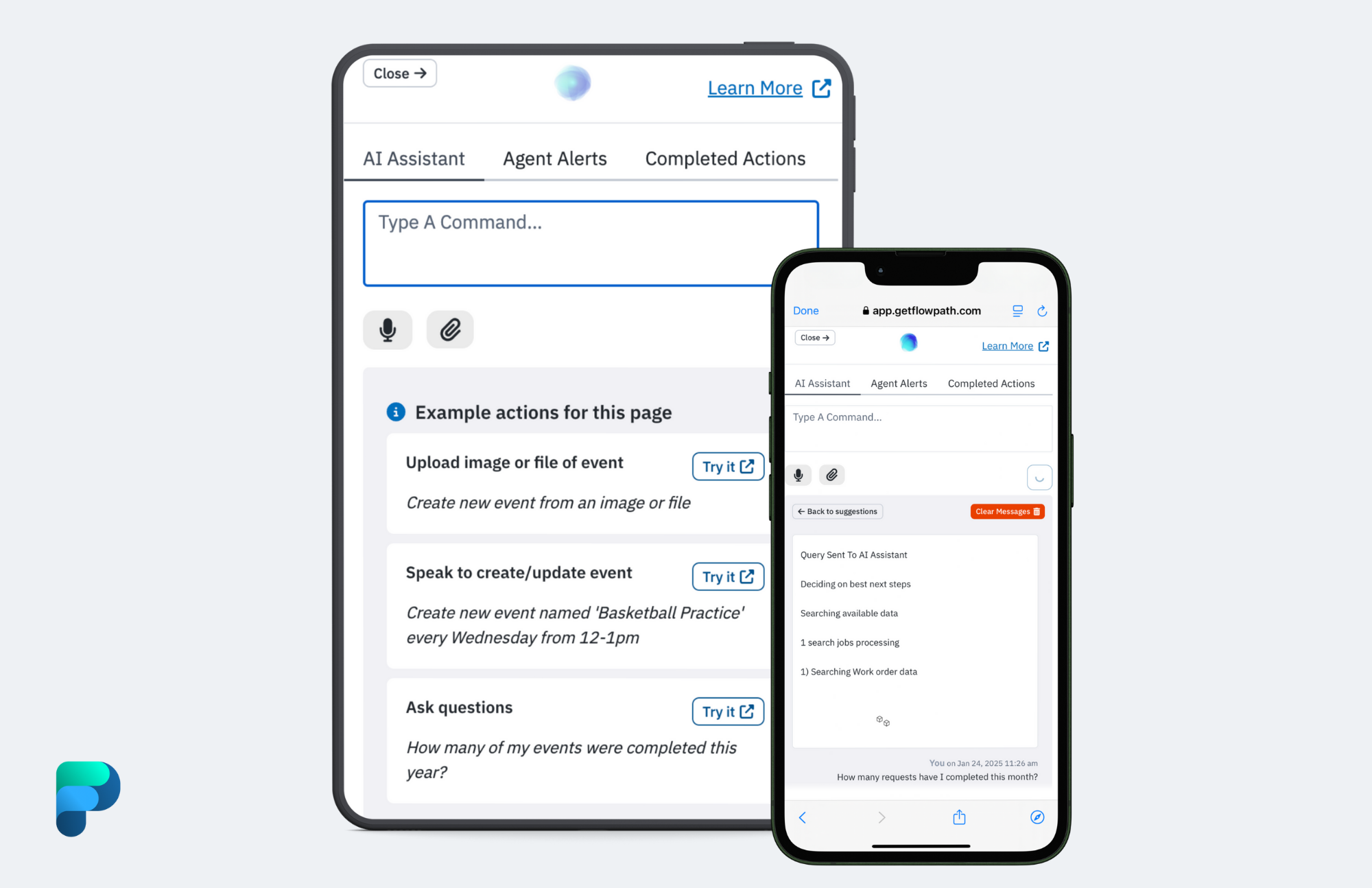
FlowPath’s AI tools help analyze patterns, recommend maintenance plans, and prepare teams for more advanced workflows—even if you're not running full PdM yet.
Scalable for Future Growth
As your data maturity increases, FlowPath helps you transition from a purely preventive approach toward a more predictive one.
If you’re ready to strengthen your preventive maintenance program today—and prepare for predictive workflows tomorrow—FlowPath gives you the tools to make it happen.
Book a demo today to learn how FlowPath supports both preventive and predictive maintenance strategies.